So you just started a new digital ad campaign – paid search, display, or video – and you’re understandably excited! But then you notice that you’re not seeing your ad. Is something wrong with your campaign? Probably not. It’s not unusual to not see your own ad, for a number of reasons. Let’s take a look at why this might be happening.

paid search

Your paid search campaign started and you keep searching for your business name or industry keywords, and your ad isn’t appearing. Why? Search engines are designed with in-depth, algorithm-based rules and preferences to determine intent and what ads to serve – and those algorithms undergo some amount of change almost every day! Since paid search is an auction system with real-time bids, a search that happens now will show different results than a search that happens five minutes from now.

There are many factors that will affect whether an ad will show such as day of the week, time, device type, bid, competitor bid, etc.

If you’ve previously searched and your URL has come up organically and you did not click it, or clicked it and closed quickly, the search engines think that you’re not interested in that site so they won’t show it to you in a paid ad. Searching repeatedly and not clicking on any ads or links will actually lessen the chances of seeing your ad, since the search engines think that you’re not interested in the types of ads they’ve been serving.

Additionally, if you do see your ad after searching on it, clicking on it will cost you money (since it’s a pay per click product). If you leave your site right after clicking the ad, the search engines will think your ad is less relevant, which negatively impacts your campaign’s performance. However, seeing your ad and not clicking it also hurts the campaign, because it thinks your ad is less relevant. As tempting as it is, it’s best to refrain trying to find yourself on paid search.

display and/or digital video

The main reason why you may not see your display or video ad is the size of the Real Time Bidding environment. Our ads and videos run across 20+ ad exchanges – that’s thousands of sites and streaming platforms. Think of it like running TV commercials on every single channel at random times throughout the day. Grab a remote and start channel-surfing, and it’s still unlikely to find your ad, even though we know that it is running.

Many of our campaigns use layered targeting to serve your ads to the right audience. Maybe your profile falls outside that target demographic, or you’re not considered in-market for a product or service because you haven’t shown a historical interest in it.

There are many qualifiers and factors that go into whether you see your ad or not, so not seeing an ad is not an indicator that something is wrong with your campaign.
Brand safety has always been a concern in digital marketing, and businesses are more aware than ever about ensuring their ads are served beside appropriate content and being seen by actual people – not bots. We utilize several tools to ensure that your ads are placed alongside quality content and seen by humans.

implement preemptive strategies

We implement preemptive strategies which can maximize brand safety for any business. Sites that are deemed unsafe for brands, that have signs of fraudulent traffic, or provide otherwise controversial content are added to a global blocklist so none of your ads are seen on those domains. Our website crawlers spend 24 hours a day, 365 days a year reading sites to determine the content and keywords on the page so your ads will only be served on appropriate pages. Since new content is being created all the time, this system updates in near real-time to quickly classify the content.

Protect your Campaigns

We protect your campaigns against bots by using both IAB (Interactive Advertising Bureau) and OTA (Online Trust Alliance) Bot Lists during campaign setup – these sources identify and publish discovered bots and ad fraud traffic. We also use RiskIQ to detect malware and non-human traffic, as well as Comscore to remove botnets, click farms, pay-per-view networks, and nonhuman traffic. If bot traffic does somehow get through, that data is ‘scrubbed’ (removed) from your campaign dashboard and reporting, so the results you see are for actual human traffic.

So what exactly is native? It’s paid content – articles, images, infographics, etc – that align with the tone and style of the publication or site its posted on. Essentially, it blends in with the organic content around it.

81% of consumers trust content on publisher sites

Three out of four publishers offer some form of native advertising on their websites, and 41% of brands are currently using native advertising. Native ads can be interesting, informative, and promote a product or brand. The key is that it is non-disruptive – it exposes the reader to advertising content without sticking out.

Why are brands increasingly turning to native? It’s effective – 81% of consumers trust content on publisher sites, and native ads create an 18% increase in intent. Native also fights ad fatigue, which happens when the audience gets bored with seeing ads. Native provides brand exposure cloaked in editorial content, so they don’t tire out the audience. As long as the content is relevant and interesting, native advertising engages the audience.

see it in action

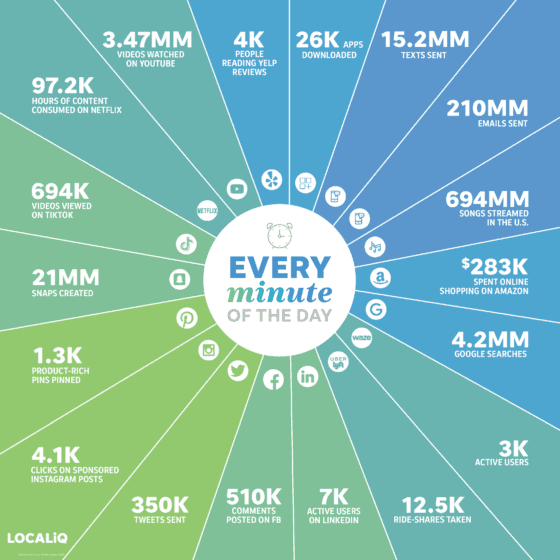
Lots of things can happen in one minute. Your heart will beat 60 – 100 times. Your eyes will blink 15 – 20 times. 210 million emails will be sent. 510,000 comments will be posted on Facebook.

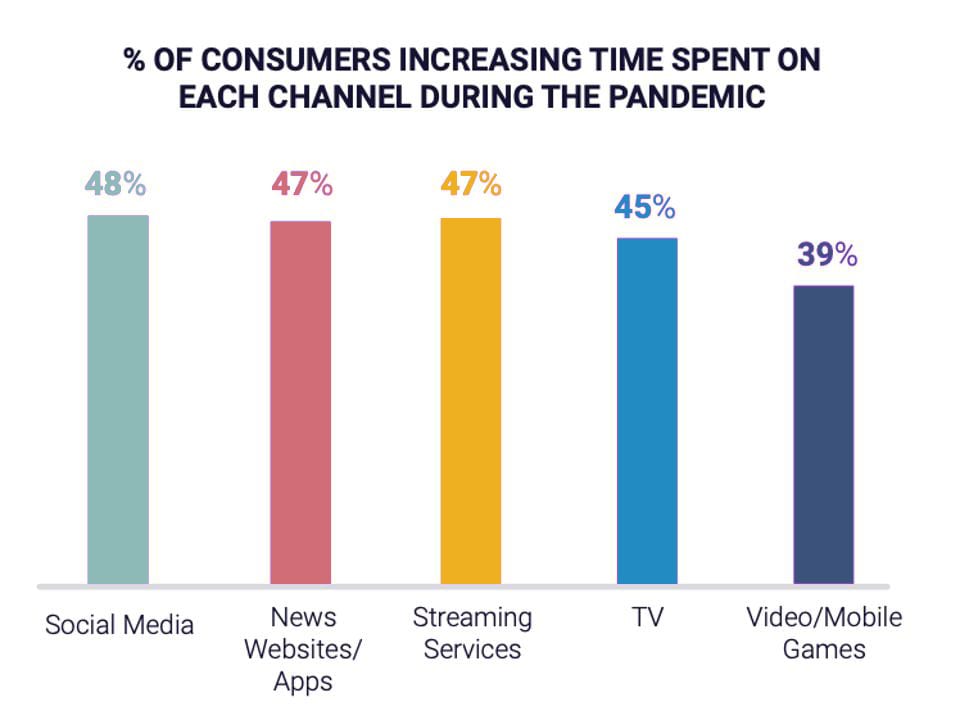
In the last year, the time consumers have spent online has only increased. Online content consumption nearly doubled in 2020, compared to 2019!

Taking a look at what happens in just one minute on the Internet tells us it’s important to get in front of today’s busy – and distracted – consumers!

here’s just a few of our favorite digital statistics!

  • google

2 million searches happen on Google every minute!

46% of those searches have local intent, and 81% of users searched online for a product or service specifically to make a purchase.

  • streaming services

Streaming video services account for nearly 20% of TV viewing in the U.S.

People spent an average of over one hour on streaming services each day in 2020 (2x higher than 2019!)

  • tiktok

TikTok was the second-most downloaded app in 2020.

They have the highest engagement rate per post across social media sites.

  • snapchat

Snapchat is the second-most visited social platform in the U.S.

Users are more likely to make purchases from their mobile device than non-Snapchat users.

  • facebook

Facebook users click an average of 12 ads every month.

Users spend an average of 34 minutes every day on the site/app!

  • youtube

70% of people made a purchase from a business after seeing them on YouTube.

90% say they find new brands or businesses.

  • twitter

350,000 Tweets are sent every minute on Twitter.

Video views increased 62% from 2019 to 2020!

  • instagram

The average user spends 30 minutes per day on Instagram.

81% of users use Instagram to research products and services.

  • linkedin

40% of LinkedIn users visit the site every day.

It’s the most trusted social network in the U.S.

  • emails

6 billion emails are sent and received every day.

By now, you’ve likely heard at least rumblings about updates to Google Cookies, and probably heard about Facebook updates on iOS, as well. While these two sets of updates aren’t related, they are rolling out at around the same time. So just what are these changes, and what do they mean?

google cookies

Last year, Google announced that they would be phasing out third-party cookies by 2022, but first-party cookies are not affected. (First-party cookies are created and stored by the website you are visiting directly, while third-party cookies are created and placed by third-parties other than the direct website).

When Google made this announcement, there was speculation that they might be developing new technologies as ‘workarounds’ for things those cookies were currently being used for. Google has now firmly stated that they will not be replacing third-party cookies with something equally invasive – this is the part that has been in the news recently.

While some of our campaigns and digital tactics use first-party data, none of them use third-party data. Therefore, our campaigns and tactics will be unaffected by this change.

facebook and ios updates

Apple has announced new changes to their privacy settings with their new operating system, iOS14. The App Tracking Transparency framework will now require apps in the App Store that engage in “tracking”, to show a prompt to users to allow them to choose whether they wish to be tracked by that app or not. This new policy will prohibit data collection unless a user opts into tracking.

As more users opt-out of tracking, personalized ads and performance reporting will be limited. These changes to iOS14 will impact data collected from tools such as the Facebook pixel. The information collected can be used for various things such as retargeting website users and view the journeys of website visitors. Traffic ads that optimize for certain pixel events such as landing page views, will be affected by iOS14.

The App Tracking Transparency framework has yet to be fully implemented and the effects of this policy on Facebook ads are constantly changing. We will not fully know the effects of iOS14 on our ads until the policy is in full effect.

Millennials make up 22% of the U.S. population. That makes them the largest generation in the country’s history. Now that millennials are between the ages of 22 and 36, it’s essential to understand their spending habits. 60% of millennials stay loyal to the brands they love. By focusing on the millennial age group, you can build a loyal fan base for your business.

You’ll need to learn the secrets of marketing to millennials first. Here’s some tips to reach the largest living generation of shoppers.

Millennials want to forge a connection with brands. Content marketing can help you build brand trust and ensure you reach your target audience. It’s important to understand your audience as much as possible. Millennials want to engage with brands that feel real and authentic. Content marketing can help forge an emotional connection with your buyers.

Post content on your website, blog, or social media accounts. Try to create unique, informative content that demonstrates your industry expertise and shows off your brand’s personality. Don’t focus on selling your products. Instead, show readers the value you have to offer. Let your experience and expertise shine through. Forging this authentic connection with your audience will help you attract them to your brand in the future.

Complete a thorough business assessment and determine your marketing objectives. Why should customers trust you? What do you have to offer that no one else can?

Focusing on your brand value can give your customers a reason to trust you. Building brand trust will help you retain customers, turning them into loyal fans.

One way to do this is to rely on your existing, happy customers. Ask them to post their happy reviews on your Google My Business listing or website. These reviews will act as social proof, which can help future customers trust you.

This generation has all the information they need at their fingertips. To cut through the noise, you need to remain transparent and authentic. Customer reviews will help you show prospects the benefits of choosing your business. Meanwhile, behind the scenes content can give them an authentic look into how you run your business.

Make sure you’re staying social! Post your website content on social media to keep your customers engaged. Make sure the content you post is high-quality and share-worthy.

When your audience shares your content, you have the chance to reach an even broader range of customers. You can also use social media to start two-way conversations. Make sure to respond to comments or messages quickly. That way, you’re showing your target audience that you’re there and eager to help. If your customers have problems or complaints, don’t ignore them. Otherwise, it could speak negatively about your brand.

A full 84% of millennials say user-generated content has some influence on what they buy. If you want to reach millennial buyers, try using user-generated content. By helping you build brand trust, this content will help customers connect with your brand. They’ll see happy consumers like themselves and recognize you’re someone they can trust.

Remain relevant to your audience of younger consumers! By marketing to millennials, you can grow your business and retain long-lasting business.

Last year marked an inflection point for video viewership. More than ever, people around the world relied on streaming platforms as their primary way to watch video. While we may be eager to put much of 2020 in the rear view, some trends – like video viewership – are here to stay. Here are a few ways advertisers are adapting to drive results.

reach consumers where they are: streaming

People are watching record amounts of digital video. According to a Nielsen study, YouTube reached more adults ages 18 to 49 in the U.S. than all linear TV networks combined in March 2020. And the screen where viewership is growing the fastest? The TV screen. That same month, watch time of YouTube TV screens jumped 80% year over year. Forward-looking brands are making the most of reaching these engaged audiences. For example, when COVID-19 forced the closure of car dealerships across Canada, Kia recognized the scale and impact they could achieve on YouTube, seeing a 16% increase in digital leads and a 15% increase in market share.

embrace the move to e-commerce

In response to dramatic changes to shopping behavior, brands have made quick pivots to e-commerce to reach and engage potential customers across the purchase journey. Around the world, online video is proving to be a powerful performance driver. New research shows that 70% of viewers in the U.S., Mexico, and Colombia say they bought a brand as a result of seeing it on YouTube. More and more advertisers are seeing results from videos with action-oriented formats, collectively driving nearly 1 billion conversions in a year.

combine creative fundamentals with innovative formats

In the early days of the pandemic, brands had a lot of questions about how to build the most relevant, effective creative for this unprecedented time. What we learned: Business-as-usual ads that focused on the core fundamentals performed best. While brands didn’t necessarily have to make coronavirus ads to drive results, most recognized the need for agility and adapted creative to be relevant to people’s needs and mindsets. Brands that drove impact used innovative creative approaches and relevant ad formats to respond and get closer to customers.

double down on brand building

Too often, longer term brand-building investments are cut first during a crisis, even when they’re critical to business growth. A study by Nielsen and YouGov analyzing sales and brand lift data across 20 CPG brands found that advertising yielded an 84% greater ROI when accounting for the long-term impact of brand lift metrics on sales. In other words, for every dollar of short-term return on ad spend, changes in brand equity yield an additional $0.84. On YouTube, brand building is particularly effective, with lift metrics 2.1X higher on average compared to linear TV.

evolve your measurement to drive results

Too often, longer term brand-building investments are cut first during a crisis, even when they’re critical to business growth. A study by Nielsen and YouGov analyzing sales and brand lift data across 20 CPG brands found that advertising yielded an 84% greater ROI when accounting for the long-term impact of brand lift metrics on sales. In other words, for every dollar of short-term return on ad spend, changes in brand equity yield an additional $0.84. On YouTube, brand building is particularly effective, with lift metrics 2.1X higher on average compared to linear TV.

Source: https://www.thinkwithgoogle.com/marketing-strategies/video/video-results

We’ve seen no shortage of new logo designs in 2020, ranging from the successful to the downright baffling, and it’s likely we’ll be seeing just as many in 2021. After all, being the first thing many people see, a company’s logo is probably the most important aspect of its branding.

Here’s some of what you can expect from the world of logo design in 2021, along with several examples from the past year. Some predictions aren’t exactly surprising – it’ll probably come as no shock that minimalism is top of the list. Flat, simplified logos have been all the rage for years, with countless companies opting for minimal versions of their existing designs. Several brands including Facebook Messenger and TrueCar have adopted gradient-filled designs lately, and 2021 is predicted to be all about neon shades and bright, saturated colors. Meanwhile, from symmetrical shapes to the clean, thin lines of logos such as Rolls-Royce’s impressive new symbol, we can also likely expect to see lots of neat and refined designs next year – just the tonic after the chaos of 2020.

Source: CreativeBloq

Geofencing is one of the most hyperlocal targeting strategies you can use to reach your audience. Each mobile device uses GPS, Wi-Fi and radio frequency (RFID) to give off its location, allowing you to reach consumers in a specific concentrated area. Within the broader geofence umbrella, there are 3 unique ways that you can target your audience:

Standard Geofence

Standard geofence allows you to choose locations such as competitors, nearby locations, etc. Devices inside those fences are ‘tagged’, and ads can be shown to those users for up to 30 days after they leave the fence. You can also target events to reach attendees and retarget your message to them.

Addressable Geofence

If you have a list of current or former customers, this tactic could help you reach them! Addressable geofence targets consumers based on their specific households. The address list is matched against plat lines (showing how land is divided in your county, with the size and boundary locations). Devices within those locations are ‘tagged’ and updated daily, and consumers using those devices can see your ads wherever they go.

Curated Geofence

Curated addressable works similarly to addressable, but you don’t need a customer list. We build out (or curate) a list of households that meet location and demographic criteria of your target audience. We can target demographically (age, gender, household income, number of children in the household, etc) and psychographically (for those interested in areas such as arts, travel, sports, home improvement, finance, and many more). Think of it like direct mail – only it’s digital and trackable.

Geofence ads are a great way to reach your audience, and there are many options to help ensure you’re targeting the people you want to reach. We’d be happy to talk with you more about geofencing and how it could help your business!

You may not be rocking around the Christmas tree or seeing Mommy kissing Santa Claus this year, but the holiday season is right around the corner. Amid a pandemic and economic downturn, this year’s festivities are likely to look much different than usual. Consumer behavior has changed this year, and the continued presence of the virus will have positive and negative consequences.

On a positive note, a consumer insights survey revealed that consumers aren’t planning to significantly change how much they spend this holiday season. One thing that is changing, though, is how they plan to spend – nearly 70% of survey responders indicated that they plan on increasing their online purchases, while 60% plan to spend less in brick-and-mortar locations.

While the 2020 holiday season looks to be mostly virtual, at least people are still planning on spending! There are a few ways you can prepare to help your consumers adapt to the changes.

Focus on Personalization

Two-thirds of respondents said they expect personalized experiences once they’ve interacted with a brand. Ensuring that the commerce experience is personalized and relevant, particularly for returning customers, can help increase conversions and build consumer loyalty. Another way to do this is by showing your consumers how valuable they are to you. Sending a thank you card or email is a simple act that can motivate consumers to support your business this year.

Offer the Best Consumer Experience

While the holidays are often a joyful time of year, they can also cause stress – and this year more than ever. Perhaps consider providing useful tips and tricks to help alleviate some of that stress, focusing on content that relates to your products or services as well as consumer needs.

Polish Your Messaging

It’s more important than ever to plan your messaging strategy. Keep it professional and consistent, but above all else, keep it authentic. Communicating for the specific context of your audience is key – for example, budget concerns may require an emphasis on return policies. While people are looking for joy this season, it’s also important to make sure any emotional marketing feels genuine and isn’t too over-the-top.

The way people are spending may be changing, but the silver lining is that they are still planning to do so. You may need to broaden marketing strategies to incorporate these new behaviors so you don’t miss out on valuable consumers — both now and after the holiday season.